
Our First Cognitive Partnership
And how it helped our ancient ancestor survive

I’m writing the Linking Your Thinking book (ETA Spring 2027). To start an early chapter, I wrote this draft about a prehistoric person. I really like it, but it wasn't right for the book. Sometimes you have to kill your darlings. At least I can share it with you here.
What do you think?
He first felt the pain.
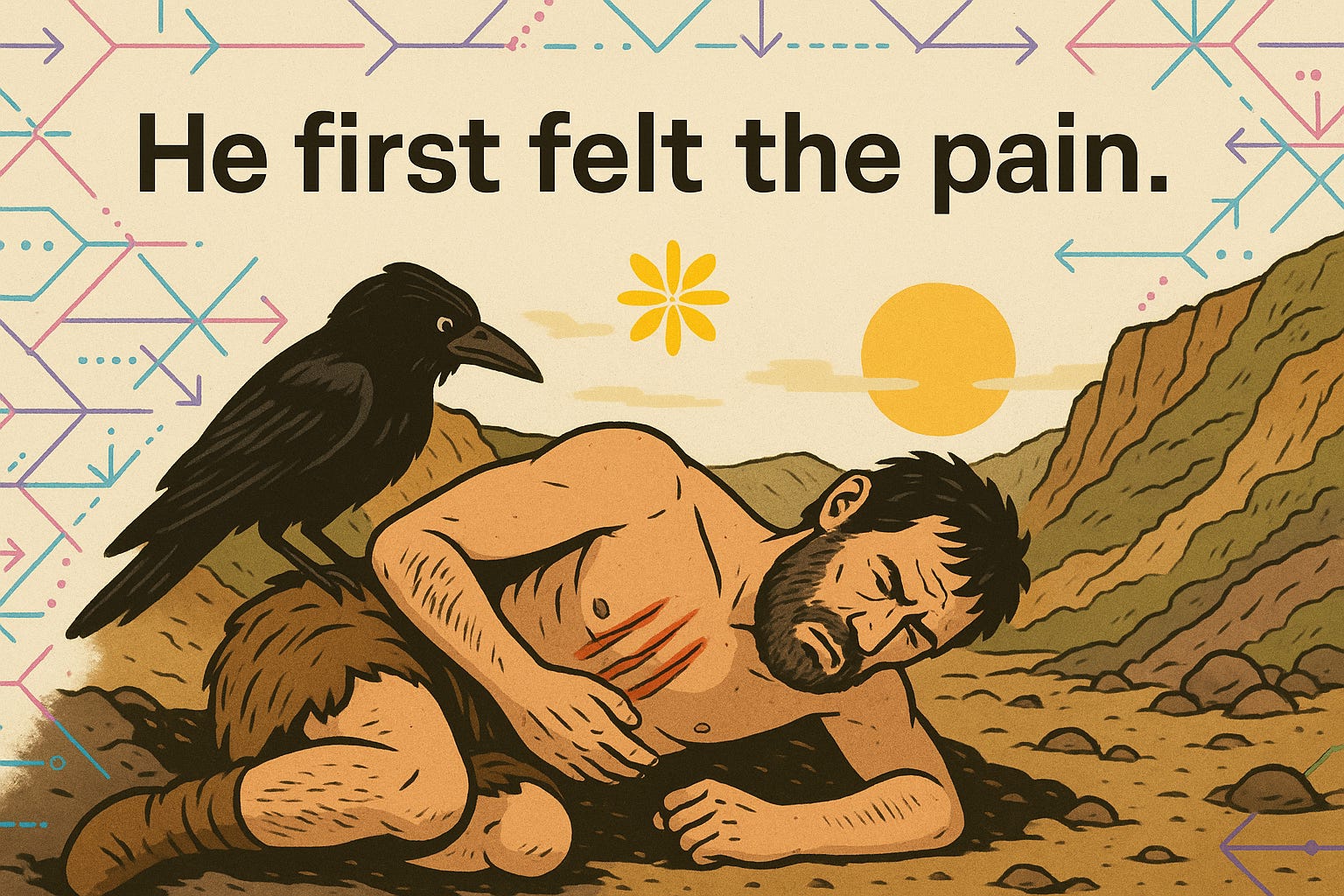
A sharp bite into his side from a crow pecking at him. He swatted it and jerked away, seizing in pain. Something wasn't right. Modern medicine would have diagnosed him with three fractured ribs, a concussion, and a badly sprained ankle.
But he just knew he was in trouble. His mind started asking questions, "Am I dying? Where am I? How long have I been here?"
He wasn't dying, yet, but was in intense pain. He lay at the bottom of a twenty foot cliff. And judging by the sun, he was unconscious for half the day.
Who was he? An ancient ancestor of ours, 100,000 years ago, in the African Rift Valley, who started hiking for a hunt before the sun had risen, and now it was directly staring down on him. We would have estimated him to be unconscious for several hours.
This was new terrain for him and just as the sun was rising, he had slipped and fallen down the slide of a small cliff, sustaining injuries to his leg, ribs, and head—with no one in the world around to help.
He was two hours from family, and with one good leg it would take everything he had to make it back alive, but as he looked around at the endless repetition of steep-sided gullies and mini canyons created by seasonal rivers, he faced the biggest problem of all: which way was home?
With his concussion, his short-term memory couldn't remember any details, other than one: he was walking toward the sunrise. With that one piece of information, he knew enough. If he walked toward the setting sun, he could find his way home.
Our ancient ancestor did just that, and by sunset, he made it back to his family.
What do you think?
Don’t worry, I have an equally interesting but faster and more interactive intro to this chapter in the upcoming Linking Your Thinking book (ETA Spring 2027). In that chapter, I elaborate on the term “cognitive partnerships,” how using an ideaverse is a special partnership, and how to create your own.
Interested to see the full body of work.